


Thanks to the constant assault on sensible and cheap energy in the Centennial State, Colorado Springs Utilities finds itself in a complex position: rising demand, transmission bottlenecks, deteriorating winter reliability, and the Nixon coal plant scheduled for retirement before its replacement resources, not surprisingly all “renewable” energy sources, are fully in place.
These are serious operational constraints. They deserve serious reporting.
Instead, readers of the “independent” Colorado Sun last were treated to something else entirely: an uncritical amplification of a study commissioned by the Malthusian “Colorado chapter” of the Sierra Club claiming that keeping the Nixon coal plant open or exploring small modular nuclear reactors (SMRs) would be “the most expensive options by far.”
The “journalist” Michael Booth whose tagged as a “subject specialist” presented these findings as fact, despite withholding even a link to the actual “study” from readers and failing to interrogate the assumptions that produced its conclusions.
If this sounds like advocacy masquerading as journalism, that’s because it is and this is what the Sun does best.
To add further red flags, as explained earlier, the “Colorado” chapter of the Sierra Club commissioned the “study” but the “study” was allegedly done by the Boston-based Applied Economics Clinic, whose website features a large text wall of virtue signaling as if they’re still stuck in the summer of 2020.

This “study” is nowhere on their website either.
At the bottom of the article, the Sun assures readers that its stories are “based on facts… verified from knowledgeable sources.” But there is no verification here. There is no link to the study, no methodological summary, no engagement with outside and legitimate expertise such as the folks at the Independence Institute.
And what is being repeated deserves far more scrutiny than the Booth is willing to apply.
The only analytic window readers are given is a screenshot of a cost comparison chart supposedly from the study that looks unmistakably like a Lazard Levelized Cost of Energy (LCOE) analysis.
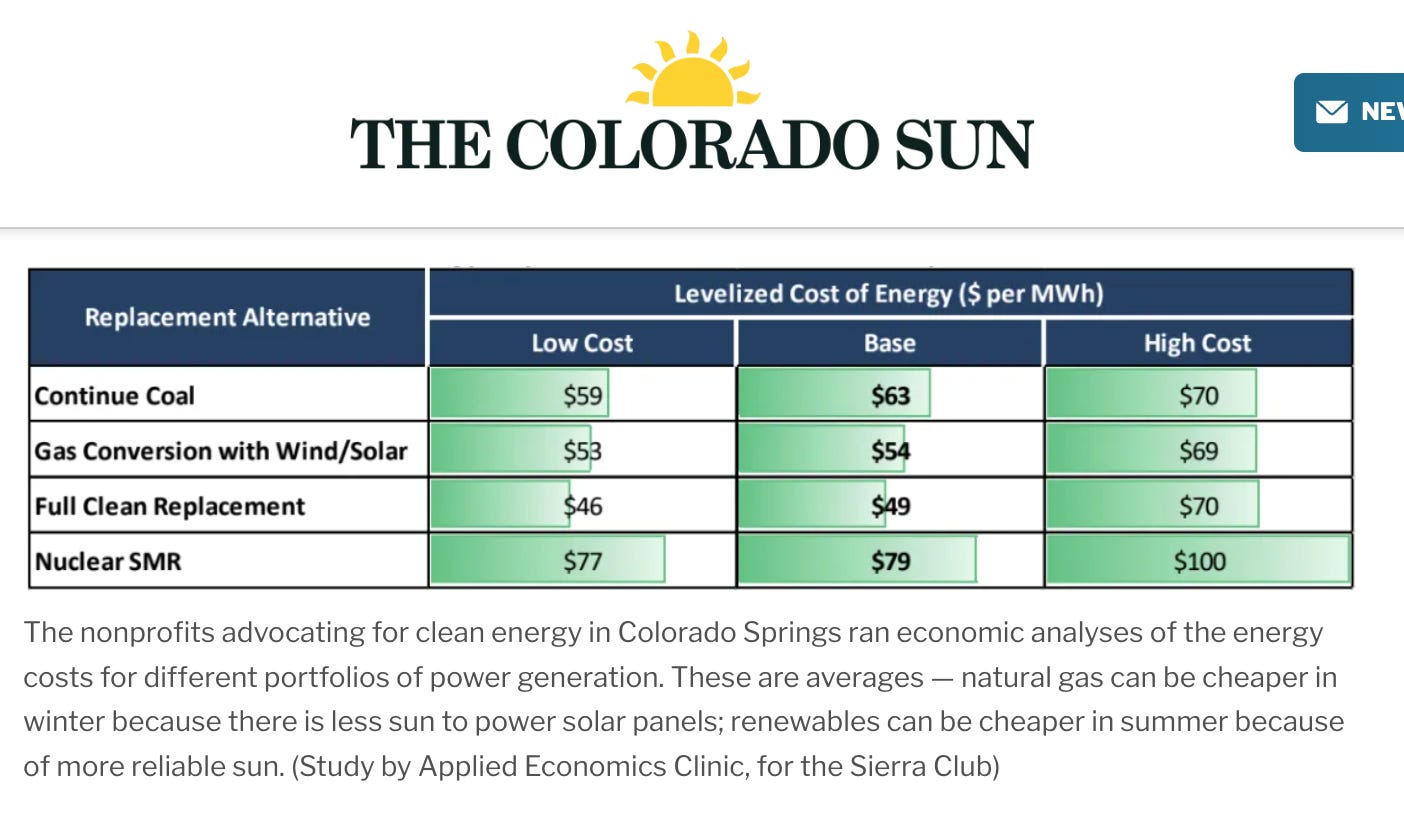
LCOE is a metric widely used by fiat energy apologists because it produces the answers they prefer: that wind and solar are always cheapest, nuclear is always expensive, and traditional baseload plants are relics of the past. The problem is that LCOE is not designed to answer system-level questions, and even Lazard openly warns it should never be used as a planning or forecasting tool.
A recent technical critique by Isaac Orr and Mitch Rolling , Cooking the Books 2: Lazard’s Levelized Cost of Energy Estimates for Wind, explains exactly why as does a 2023 piece by Doomberg
Lazard’s LCOE calculations exclude every major cost of integrating renewables into a real-world grid: transmission expansions, congestion, curtailment, weather variability, load balancing, overbuild requirements, and storage needs. As Lazard itself even concedes, these omissions “may have a significant effect on the results” and “this analysis is not a forecasting tool.” Yet forecasting is precisely how the Sierra Club “study” uses it, and precisely how the Booth “reports” it.
Worse still, LCOE depends on unrealistically generous assumptions for wind and solar. Lazard’s low-end wind cost, for example, is based on a 55 percent capacity factor — a performance level achieved by only 0.33 percent of U.S. wind turbines. The national fleet average is roughly 35 to 43 percent depending on vintage, and Colorado’s seasonal variability can push actual output far lower during critical winter peaks. If a model assumes output that wind turbines do not and cannot produce, it will, unsurprisingly, produce cost projections that are divorced from reality. And yet the Booth saw no need to report on whether the “study” relied on these same assumptions.
Also consider the way the Booth presents Colorado Springs Utilities’ current resource mix. We are told the utility has “175 MW of solar, 60 MW of wind, and 100 MW of battery storage.” These are nameplate capacities, not actual output - a common bait and switch tactic fiat energy apologists do. In Colorado’s climate, 175 MW of solar averages closer to a fraction of that figure of real energy over the year — and near zero on winter evenings when reliability risk is highest. Sixty megawatts of wind reduces to roughly 20–25 MW on an annual basis, with large multi-day lulls not captured in any average. A battery’s MW rating tells readers nothing without its energy duration either. 100 MW of storage may mean just one hour of output. Booth failed to give us those details.
Booth appears unaware that a megawatt of nuclear or gas is not remotely equivalent to a megawatt of solar or wind. LCOE treats them as interchangeable. The grid (and reality) cannot.
To Booth’s credit, he included a statement from someone at Colorado Springs Utilities who explicitly flagged these issues, noting that the so-called study “does not appear to account for weather variability, growing customer demand, high-load users such as data centers, regional transmission constraints, or reliability modeling.” In other words, the study ignores the factors that determine whether the lights stay on.
The Sun relegates this to a single paragraph.
Then the paper returns to quoting more activists.
The central claim of the Sierra Club’s analysis — that nuclear small modular reactors would be “the most expensive option by far” — rests almost entirely on the same flawed LCOE structure Orr and Rolling dissected: unrealistic capacity factors, optimistic asset lifetimes, misleading cost allocations, and the complete absence of grid-integration costs. But without access to the underlying study, readers cannot see whether these assumptions are present. But the clip of the chart, the rhetoric of the conclusions, and the reporter’s own presentation strongly suggest they are.
This is precisely why the Sun should have linked the study. It did not. And without that transparency, readers are left to take an advocacy group’s claims on faith — something the Sun’s ethics policy supposedly exists to prevent.
Colorado’s energy debates are too important for “news” outlets to act as message multipliers for political nonprofits. Utilities face a genuine challenge: meeting growing electric demand while maintaining reliability, complying with state mandates, and avoiding rate shocks. That conversation requires clarity, accuracy, and intellectual honesty. It requires distinguishing between nameplate capacity and real energy, between annual averages and seasonal peaks, between cost estimates on paper and performance in practice.
What it does not require is media laundering of an unlinked, methodologically suspect analysis.
“Journalists” often defend themselves as guardians against misinformation. If that is true, then the minimum obligation is to provide readers with the information necessary to evaluate a source — starting with a link to the study the entire article is built around.
We forget that Lazards is an investment bank. It is not an unbiased analyst. They want to loan more money every day. I cannot think of anything that would require more loans than replacing the electric grid. They have an agenda. They cannot be trusted.
Hello Colorado.
We love coal. Technologies have been created so that coal can be combusted almost as clean as natural gas. https://www.youtube.com/watch?v=RQRQ7S92_lo&authuser=0
A lot of AI Data Centers are also going to get power from Community MW Natural Gas Power Plants. These Community Power Plants will produce the power needed for the AI Data Center, with no connection to the grid network. AI Data Centers are coming, but people don't want to have to pay for their energy or any grid upgrades.
It's so possible. We just have to be loud and bold.
https://1drv.ms/i/c/158cd9f1a1ea245d/IQDSwQQELoMIRKxERJymKQcGASCLlcBxzk-RhlJPLUv3JRk?e=0KTYxc